Sponsored article
From Medieval Vessels to Modern Tableware — the Evolution of Polish Pottery
- The First Pottery on Polish Lands
- How the Potter’s Wheel Changed Production
- Regional Techniques and Grey Pottery
- The Development of Ceramic Centres
- The 19th Century — a Turning Point for Bolesławiec Stoneware
- Polish Pottery after 1945 — Craftsmanship and Heritage
- Why Does Polish Pottery Remain So Popular?
For centuries, ceramics have been part of everyday life, combining practical use with durability and local decorative traditions. In Poland, the development of pottery reflected changing household needs, available raw materials and regional craftsmanship. Over time, these traditions evolved into distinctive forms of functional ceramics, some of which are now recognised far beyond Poland.
The First Pottery on Polish Lands
Ceramic vessels appeared in what is now Poland as early as around 5400 BC, together with the first farming communities that adopted a settled way of life. Early pottery was primarily practical. Its purpose was to store grain and other food, prepare meals and hold or transport liquids.
Vessels were initially formed by hand from locally available clay. Mineral or organic temper could be added to the clay body to improve its working properties and reduce the risk of cracking during drying and firing.
Although these early objects were far removed from modern tableware, they established a craft tradition that would continue to develop for thousands of years.
How the Potter’s Wheel Changed Production
During the Middle Ages, the potter’s wheel became increasingly important in ceramic production. It enabled craftspeople to create vessels with more regular shapes, thinner walls and increasingly refined profiles.
Forms were adapted to the requirements of everyday cooking and food storage. Potters produced deep cooking pots, jugs with narrower necks, bowls and other vessels designed for practical household use.
The growing specialisation of pottery also meant that individual workshops could produce larger numbers of vessels while maintaining more consistent shapes and dimensions.
Regional Techniques and Grey Pottery
The availability of different types of clay and variations in firing techniques gradually contributed to the emergence of local pottery traditions.
In parts of Poland, especially in central and eastern regions, potters produced distinctive grey or blackened ceramics known as siwaki. Their colour resulted from reduction firing, in which the supply of oxygen to the kiln was restricted during part of the firing process.
These vessels remained an important part of rural household equipment for generations and are one example of how local firing methods influenced the appearance of Polish ceramics.
The Development of Ceramic Centres
As towns expanded and craft guilds became increasingly important, specialised centres of ceramic production developed across different parts of Poland.
Access to suitable raw materials, transport routes and growing demand all influenced the development of the craft. In later centuries, places such as Włocławek, Ćmielów and Wałbrzych became associated with different branches of ceramic production, including faience and porcelain.
Each centre developed its own decorative language, production methods and product range, supplying everything from everyday household vessels to more elaborate tableware.
Bolesławiec — the Origins of One of Poland’s Best-Known Pottery Traditions
Bolesławiec holds a particularly important place in the history of Central European stoneware. The area surrounding the town, located in the Bóbr and Kwisa river basins, is rich in clay suitable for stoneware production.
The pottery tradition of Bolesławiec dates back to the Middle Ages. The earliest known written reference to a potter from the town comes from 1380, while historical records from the 15th century already mention several pottery workshops.
The first surviving source confirming the existence of the Bolesławiec potters’ guild dates from 1511. The guild regulated local production and helped maintain standards among craftsmen, while the abundance of suitable clay provided favourable conditions for the continued development of the industry.
The 19th Century — a Turning Point for Bolesławiec Stoneware
The 19th century brought major technological and artistic changes to pottery production in Bolesławiec.
One of the most influential local potters was Johann Gottlieb Altmann. He experimented with improving stoneware bodies and introduced technological innovations to local production. In 1825, he developed a new type of glaze with a reduced lead content, offering a safer alternative to earlier solutions.
His work gained recognition beyond the region. Altmann received an honorary award at the Berlin Trade Exhibition in 1844 and a gold medal at the Great Exhibition in London in 1851, strengthening the reputation of Bolesławiec pottery.
Sponge and Stamp Decoration — a Bolesławiec Trademark
Another important development came around 1882, when a new type of decoration began to appear on Bolesławiec ceramics.
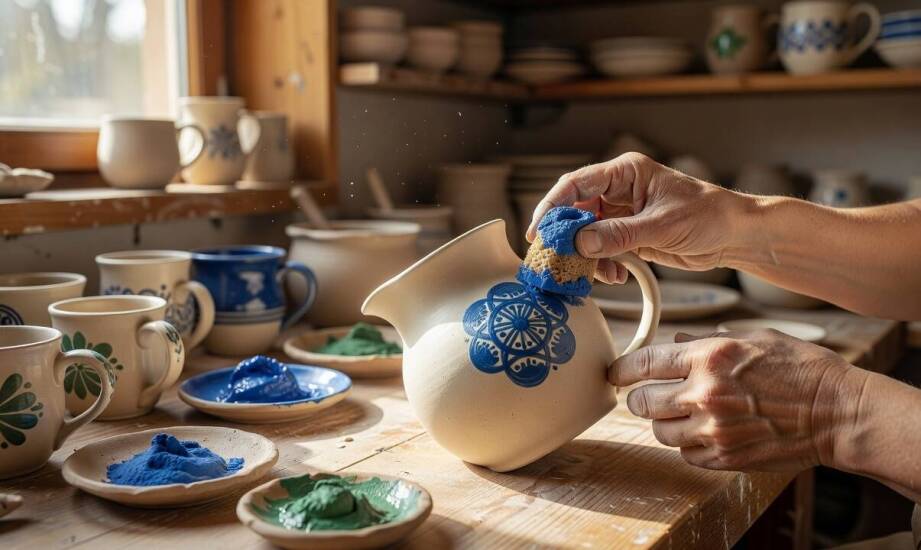
Patterns were applied with pieces of sponge, producing rhythmic motifs in colours such as cobalt blue and green. Over time, this decorative tradition developed into the characteristic stamped designs for which Bolesławiec pottery is now widely known.
Circles, dots, peacock-eye motifs, fish scales, leaves and floral elements became part of a recognisable visual language that distinguished local stoneware from other European ceramics.
Polish Pottery after 1945 — Craftsmanship and Heritage
The Second World War caused severe damage to the ceramic industry in Bolesławiec. Production began to be rebuilt shortly after the war, with one of the first workshops restarting operations in 1946.
In 1950, the artistic ceramics cooperative that later became known as Ceramika Artystyczna began operating in a former factory. Cooperation with artists and academic institutions helped maintain a high artistic and technological standard while traditional methods continued to evolve.
During the post-war decades, ceramic production became an important means of preserving and developing the region’s craft heritage. Traditional techniques were no longer viewed solely as a way of producing functional household objects — Bolesławiec stoneware increasingly became associated with regional identity, craftsmanship and collectible design.
Today, traditional hand-decoration and high-temperature stoneware firing are continued by producers such as Manufaktura in Bolesławiec. Contemporary production combines established techniques with new forms and patterns, allowing the region’s ceramic tradition to remain relevant to modern kitchens and dining spaces.
Why Does Polish Pottery Remain So Popular?
The lasting appeal of Polish ceramics lies in the combination of traditional craftsmanship, practical design and distinctive decoration.
Modern Poland pottery from Bolesławiec continues to draw on a long stoneware tradition. Pieces are made from stoneware clay, fired at high temperatures and decorated by hand using characteristic stamping techniques.
This production method gives Bolesławiec ceramics their recognisable appearance while allowing individual pieces to retain the small variations associated with hand craftsmanship.
Bowls, mugs, jugs, plates and serving dishes are no longer merely utilitarian objects. Their forms and decorations also reflect the history of a craft that has developed in the region over centuries.
Traditional Bolesławiec pottery demonstrates how everyday tableware can remain closely connected to local heritage while still meeting the requirements of contemporary homes. Practical functionality and distinctive design can exist side by side, allowing a centuries-old craft tradition to remain relevant today.
You might be interested

Professional Mushroom Supply – Why Collaborate with Experts?

How to prepare pork lip for further technological processing?
The Impact of Advanced Deburring Machines on the Quality of Final Products